


Benet Academy is known for its academic rigor. The average ACT score of the student body is a remarkable 29, and students are offered as many as 24 AP courses. Unsurprisingly, students often feel pressured to perform at a high level. It is reasonable to say that an environment like this is in fact beneficial to students. Benet has a 100% college acceptance rate and boosts kids’ résumés when applying for jobs.
Benet Academy is also recognized for its remarkable athletic performance. With 78% of students participating in a sport and 41 total state appearances in the last three years, students are evidently working hard to excel athletically. An environment like this is beneficial for kids aged 15-18. Having to balance schoolwork with sports improves students’ time-management skills. Additionally, practicing nearly every day teaches students the value of hard work.
Finally, Benet Academy offers over 50 clubs, with at least 90% of students participating in at least one. Involvement in extracurriculars teaches students leadership and collaboration skills.
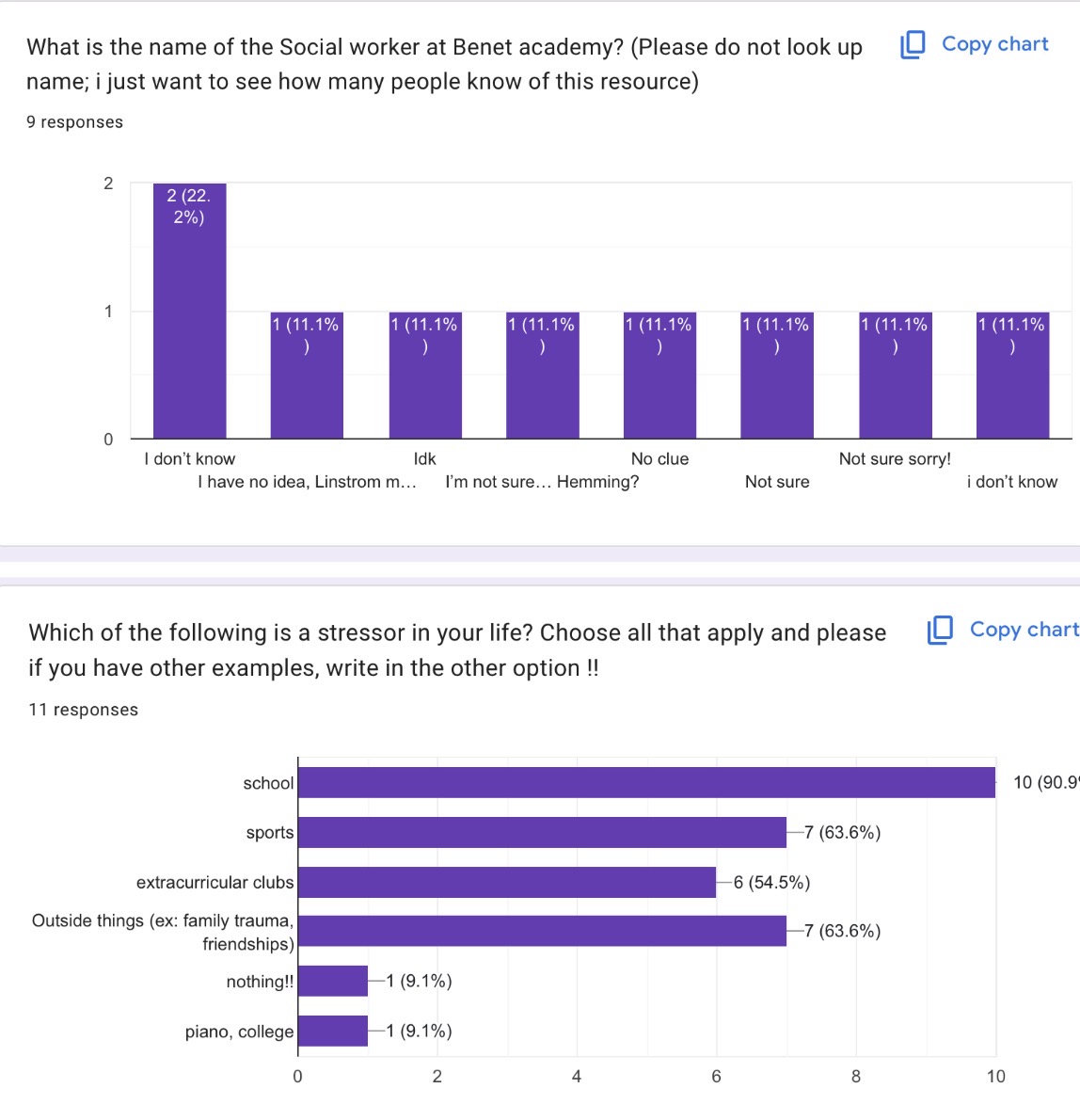
With all of this success, two questions emerge: How are Benet students faring from a mental health perspective? What resources are available at Benet to help? I sent a Google Form to some of my classmates in order to get a gauge on these answers.
I want to start by saying that many students do maintain a healthy balance between their academic and extracurricular involvements and their mental well-being. It is great for students to focus their time and effort on their studies, athletic competitions, and club service. Students can learn the life-long skill of time-management, make new friends, prepare for college, and serve their community. In addition, one of the respondents to the Google Form stated that running cross country relieves her mind of stressful thoughts.
However, good things can become harmful without balance. That is why I would argue that involvement in these considerably good things–education, sports, and clubs–are actually the same factors taking a toll on students’ mental well-being. When a student prioritizes their grades, athletic performance, and extracurricular involvements above their mental health, they corrupt their own happiness. They may begin to stay up late studying for a test instead of getting adequate rest. They may beat themself up for not reaching their unrealistic athletic and academic standards. In my Google Form, 90% of the participants selected school as a stressor in their life. Instead of being a place full of opportunity, the halls of Benet can become an environment of pressure and stress.
Since school is such a big part of students’ lives, it is extremely unhealthy to develop a negative perspective on school. Something that escalates symptoms of poor mental health is the fact that students feel alone in their struggles. However, students are not alone. Unfortunately, mental health struggles are a lot more common than people think. Asking for help is not a sign of weakness, but a sign of self-awareness and a courageous step in the right direction.
Also, Benet does a great job providing resources to make the school a less stressful space. I hope that by reading this next paragraph, readers recognize not only how normal it is to struggle with mental health, but also how many resources are set up for them. For one, the school nurse, Nurse McIntyre, has a quiet room in the back of her office with all kinds of stress-relieving toys. If students wish to take a break from stress and focus on themself, her room is always open. The Benet social worker, Ms. Heming, makes herself an available resource for students throughout the day. Her office is located right next to the counseling center, and she invites kids to come in to talk or just to sit in a quiet place. Ms. Heming can also help set students up with outside therapy. In students’ freshman year, they are assigned a counselor (Mr. Oconer for last names A-Gk, Mrs. Kothe for last names Gi-Oi, and Ms. Byrne for last names Om-Z). Almost every week, a group of students meets with their counselor in what is called “Freshman Advisory.” During this twenty minute session, students learn tips on how to deal with the inevitable stress that accompanies school. Throughout the rest of a student’s tenure at Benet, their counselor remains a safe adult for them.
Finally, and most importantly, students can always turn to God in times of anxiety, stress, sadness, or any other concern. Benet makes this “turn to God” very accessible to students with the following offerings: religious retreats, daily mass starting at 7:10, weekly adoration during 5th and 6th period, frequent opportunities for confession during 5th and 6th period, service opportunities such as Feed My Starving Children, frequent Lift meetings, and Bible Cafe meetings. In fact, Deacon Christopher, the director of campus ministry, just started the Daily Mass Challenge. Deacon Christopher encourages students to attend morning mass throughout the next five weeks. He says, “In a world that moves fast, demands a lot, and often leaves us running on empty, you are being offered something rare: a quiet place to begin your day with God.”
All in all, mental health struggles are something inevitable in a place with rigorous academics, excellent athletics, and a variety of clubs. However, the most important thing is for students struggling with mental health to realize that they are not alone. Prince Harry once said, “The experience I have had is that once you start talking about experiencing a mental health struggle, you realize that actually you’re part of quite a big club.” Our student body is truly blessed to have so many faculty members that care about us—it’s a gift that we should appreciate!