

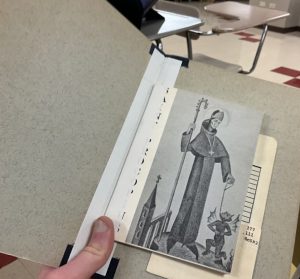
Several weeks ago, I noticed a book in our school library that looks different from all the other books in the library. This book is much thinner than all the others, and its cover is made out of marbled white cardboard. It is rather old, and neither of the two copies had been checked out in decades. Inside is a small book, printed by the Benedictine Abbey Press in 1961, “in observance of the first centenary of the birth of St. Procopius’ namesake, the Rt. Rev. Procopius Neuzil, O.S.B., 1861-1946, Abbot of St. Procopius Abbey, Lisle Ill.” This book also has a mysterious cover. On it, a tall and slender abbot holds a crosier in one hand and the Devil by a leash in his other hand. Above his head is a halo, and on his right is a monastery. After I saw the cover, I knew I wanted to learn more.
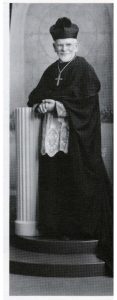
Procopius Neuzil is the founder of Benet. He taught the first class of two students on March 2nd, 1887, at St. Procopius Church in Pilsen[1]. He was also the third abbot of St. Procopius Abbey. In 1861, he was born Karel Neužil in the town of Bechyně, in what was at that time southern Bohemia. He was the fourth of five children and the son of an impoverished stonemason. In 1874, he and his family emigrated to the United States and farmed in deeply Roman Catholic Spillville, Iowa. Karel, who changed his name to Charles, had a hard time entering the priesthood due to his impoverished background and was repeatedly rejected. Finally, after earning a teaching degree, he began his studies as a priest at St. Vincent Abbey in Pennsylvania as part of a program to recruit Czech priests. Four years after beginning his studies he took the vows of a Benedictine monk, and he took the new name Procopius. According to University of Chicago Librarian Thomas Dousa (from whom most of the preceding biography of Neuzil was adapted), “This choice of name was significant, for St. Procopius was a Czech national Saint renowned for having cultivated the old Church Slavonic liturgy at Sásava and so having kept alive a distinctively Slavic form of Christianity at a time when the Czech lands had, under German ecclesiastical influence, adopted a Latin form of Christianity. To take the name “Procopius” as one’s own was thus not only to proclaim allegiance to the Benedictine Order within a distinctly Czech context but to signal commitment to the preservation of Slavic language, culture, and tradition.”[2]
This brings us to the monastery and the devil flanking St. Procopius on the cover of his biography in the school library. St. Procopius was a uniquely Czech Saint. He did things that other Saints didn’t normally do, like, return from the dead(!) to beat a German Abbot with his crosier, tie the devil to a plow, threaten to kill the Pope (also with his crosier), and he celebrated the liturgy in the Slavonic rite, in opposition to Rome. As Dr. Eleanor Janega, a guest teacher at the London School of Economics and Political Science’s department of international history, put it: “[in the medieval ages] Ordinary Czechs don’t care what the Church might think about a fantastic story that centers on chasing demons from a cave. They want a local saint who behaves like a saint, and that means living in a cave, and having mastery over the demonic.”[3]
For starters, Procopius chose to found Sásava monastery southwest of Prague in the first decades of the eleventh century in the Slavonic Rite, meaning the Catholic liturgy was celebrated in Old Church Slavonic which was a language native to Bohemia as opposed to foreign Latin. At the time, the political situation in Bohemia favored the Latin rite, although the Slavonic rite was favored by the Czech people.
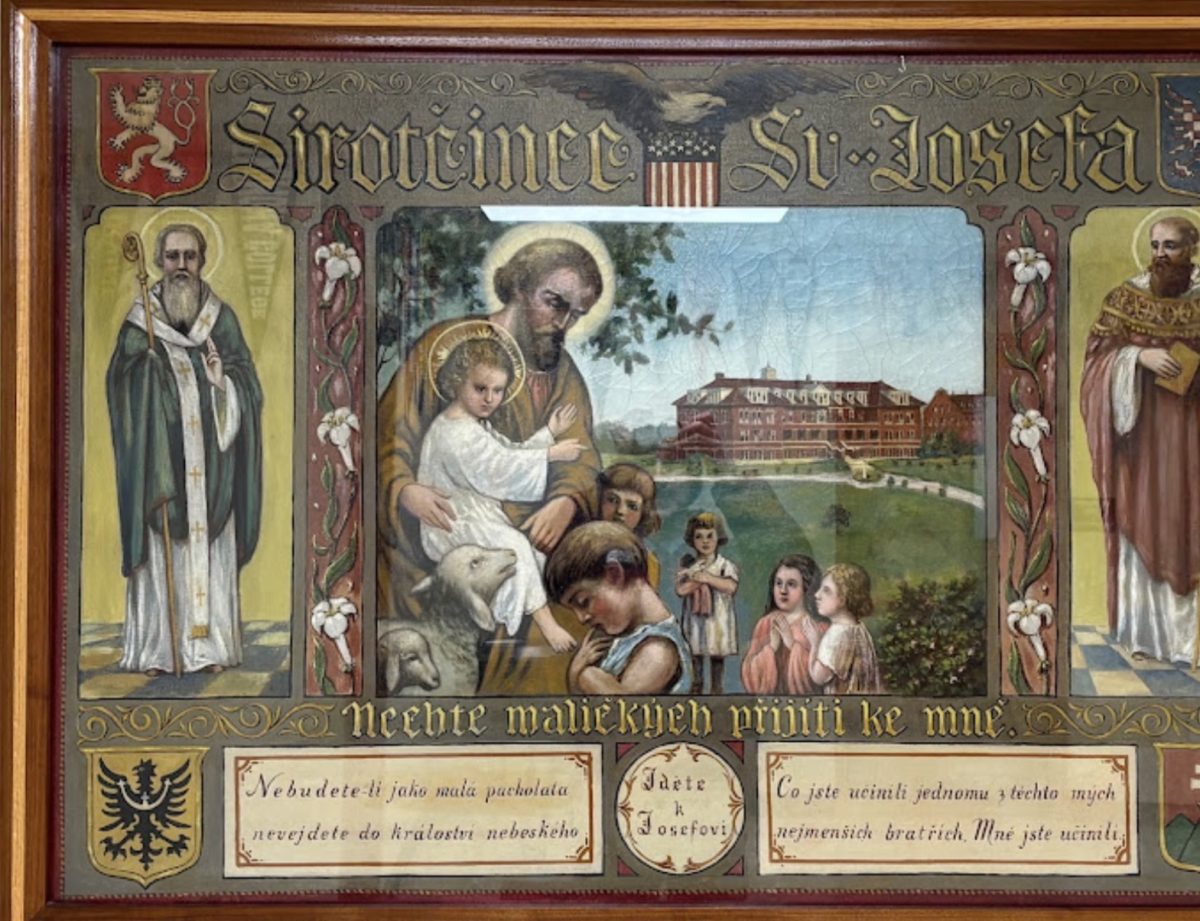
This might seem very distant from Benet, but actually, we just need to know where to look! The Slavonic rite was instituted in the 9th century by the missionary Saints Cyril and Methodius, who are depicted in a 1920s-1930s painting in St. Joseph’s Hall, which most Benet students see every day!
St. Procopius’ adoption of the Slavonic rite put him at odds with other figures in the church who favored the Latin rite. After his death, his successor was replaced by a German abbot who turned Sásava into a Latin rite monastery. So, St. Procopius, as Dr Janega relates, “According to the legend, his spirit appeared and said, ‘From whom, German, do you have a right to rule here? … Compose yourself and take yourself off, lest shame fall upon you. If you do not go, then know that God’s vengeance will come upon you’.” The abbot did not heed the warning, and was beaten over the head by Procopius with his staff until the German left. According to Janega, local Czechs loved this story because during the Medieval ages German speakers were perceived as hostile to Bohemians, untrustworthy, and were associated with Holy Roman Empire overreach.
Local Czechs also loved the story of St. Procopius plowing with Devils[4]. Sásava monastery overlooks an important road which runs through a dip in the land called the Čertová Brázada. This literally translates to “the Devil’s furrow”. The school library’s biography of St. Procopius explains, “[Procopius] tied the devil on a chain, hitched him to a plow, spurred him on with a cross which he held in his right hand, and thus plowed a ditch on the right bank of the river. This ditch is called Čertová Brázada (The Devil’s Furrow)” (Ekert). It is also said that before Procopius founded Sásava Monastery, he lived in a cave in the region as a hermit. Upon first entering the cave, he encountered a pack of demons. Dr. Janega again explains that “According to a 1379 life of Prokop, the Pasionál, when Prokop entered the cave, ‘the voices of devils were heard crying, ‘Woe! Woe! That this false cruel man lives in this cave we can no longer endure; let us rise up with all our brothers and dwell in the wasteland called Lobek. No one there could harm us more than this Prokop, who does not let us live here’’.” These stories are really cool! I’d like to see St. Benedict drive demons from a cave or beat people up with a cane! (The story about St. Procopius living in a cave was probably copied from a biography of St. Benedict). St. Procopius has endured in Czech culture for centuries by being uniquely Czech, as he is in these stories. Yet, if we dig deeper, there’s more to the story.
The original purpose of the St. Procopius cult was actually not primarily about preserving Czech culture, but rather the land claims of Sásava monastery. In the mid-twelfth century, Benedictine monasteries like Sásava were in real danger of being given away by their secular of ecclesiastical ruler to new rival orders like the Premonstratensians, who did in fact take over multiple neighboring monasteries in the mid-twelfth century.
These troubled times influenced the mid-twelfth century manuscript titled Exordium Zazavensis produced a century after Procopius’ death in the eleventh century at Sásava monastery, which is the origin of all knowledge of St. Procopius. According to Charles University Professor Peter Kubín, documents like the Exordium were common in Central European Benedictine monasteries in the tenth to thirteenth centuries and served to justify the land claims of the monastery by taking the place of founding documents, which these monasteries did not have. So, most of the story of Procopius is invented, or based on the life of St. Benedict and contemporary events of the twelfth century. At the same time, the monastery made doubly sure that it accurately reflected their property claims. For example, František Ekert tells us that “According to ancient tradition, Procopius’s father was a respected landholder, one of the elders of the village of Chotouň” (Ekert 1). Peter Kubín then reminds us that “By identifying Procopius’ birthplace, the author (of the Exordium) may have wanted to suggest that Procopius himself participated in providing for the monastery” (Kubín 65). Thus, the earliest origins of the cult of St. Procopius lie in Sásava monastery’s twelfth century desire to secure their land claims by invoking the holy reputation of the founder of the monastery.
Peter Kubín sums up his magisterial survey of all primary sources on Propocopius[5] by saying, “as to whether the first abbot of Sásava, St Procopius, really existed, we can state yes, but except of his acknowledgment to the Slavonic liturgy we do not know anything about his life” (Kubín 79).
To the modern reader, this lack of factual details about the real St. Procopius can seem disappointing, this is because in the modern world we are obsessed with certainty and objectivity. To thoughtfully understand St. Procopius, we have to abandon these expectations. The story of St. Procopius is really a journey of cultural exploration into Czech Catholicism, which is definitely worth learning about!
[1] https://ben.edu/academics/library/archives/research/ This event is the first event on Benedictine University’s timeline of their school.
[2] This quotation can be found on pages three and four of Dousa’s article, which is linked here: https://knowledge.uchicago.edu/record/14015?ln=en&v=pdf
[3] Dr. Janega has a cool blog post about St. Procopius, from which this quote and other quotes from her are taken, linked here: https://www.medievalists.net/2025/11/medieval-folktale-prokop-sazava/
[4] This phrase was borrowed from the website of Sásava monastery, which is now partially run as an historic site by the Czech Government, there are some excellent photos of the monastery. https://www.klaster-sazava.cz/en